Nutrition • 12 min read
How to Read a Dog Food Label Like a Vet (and Spot Marketing Tricks)
We may earn a commission from links on this page. It never changes our editorial advice, and KinPet is not paid to recommend a treatment for your pet.
The 30-second answer
Ignore the front of the bag entirely — it is unregulated advertising space. The back holds three legally defined items that tell you everything: the ingredient list (ordered by pre-cooked weight), the guaranteed analysis (protein, fat, fiber, moisture), and the nutritional adequacy statement — the AAFCO sentence that says whether the food is complete and balanced for your dog's life stage. The trick to master first is the naming law: 'Chicken Dog Food' must be at least 95% chicken, 'Chicken Dinner' or 'Chicken Formula' only 25%, 'with Chicken' just 3%, and 'Chicken Flavor' needs only enough to be detectable. Same brand voice, four legal realities.
Who regulates dog food labels (and what that means for you)
In the US, pet food labeling is governed by AAFCO — the Association of American Feed Control Officials — whose model rules and definitions are adopted into law by most states and enforced by state feed-control officials. AAFCO does not approve foods or test every bag; it defines the rules and the nutrient profiles, and compliance is checked by states. Translation for the shopper: the legal floor is real and you can verify claims against it, but the bag's promise and the bag's law are different documents. Front of bag: marketing. Back of bag: regulation.
The four naming rules — where the money hides
These are the four legal formulas for naming a product after an ingredient, and brands choose deliberately:
The 95% rule. 'Beef Dog Food' must contain at least 95% beef (excluding water for processing). These products exist, and they are priced like it.
The 25% rule — the 'Dinner' rule. 'Chicken Dinner for Dogs', 'Lamb Formula', 'Beef Recipe', 'Chicken Platter': any of those words means the named meat must be only at least 25% of the product (again, excluding water). 'Chicken Dinner' legally can be three parts rice and potatoes to one part chicken. Owners read 'dinner' as generosity; the law reads it as a quarter.
The 3% 'with' rule. The single most exploited word in pet food. 'Dog Food with Chicken' requires a minimum of just 3% chicken. The phrase is usually set in the same large font as the flavor photograph — a legally meaningful difference in position is all it takes.
The flavor rule. 'Chicken Flavor' requires no minimum percentage at all — only enough chicken (often rendered or a digest) for the product to taste detectably like chicken. There is no legal percentage because the test is a panel, not a scale.
Practical rule of thumb that folds all four together: the further the protein's name drifts from the words 'Dog Food', the less of it the law guarantees.
Reading the ingredient list like a formulator
Ingredients are listed by weight before cooking — and this changes everything about how you read the top of the list. Fresh chicken at 70% water weighs more on the label than chicken meal at 10% water, even after cooking removes that water: a bag whose first ingredient is 'fresh chicken' followed by corn, wheat and rice may deliver less total animal protein than a bag whose first ingredient is 'chicken meal'. Meal is not a dirty word — chicken meal is rendered, concentrated protein, and quality meals are a legitimate primary ingredient. What actually matters at the top of the list is the balance of named animal proteins versus plant fillers across the first five to seven ingredients.
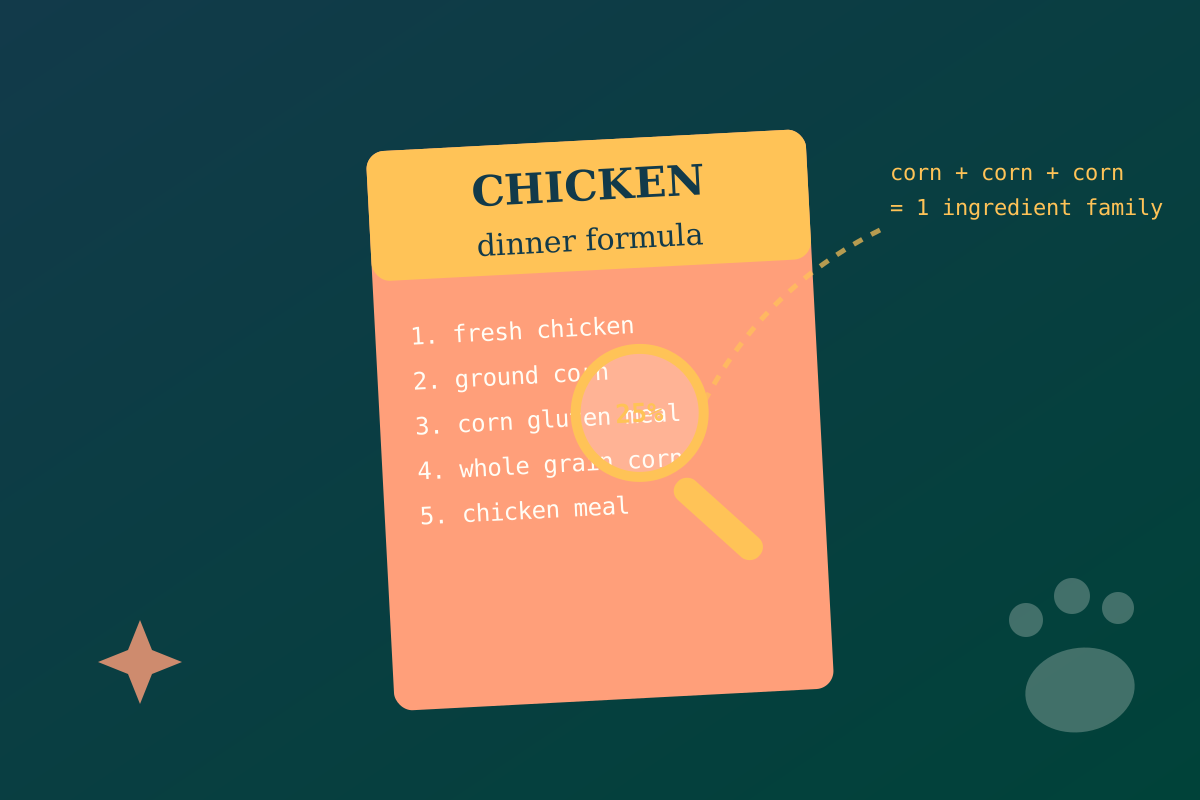
Watch for ingredient splitting: the trick of listing one family of ingredients under several names — ground yellow corn, corn gluten meal, whole grain corn — so no single filler appears first, and the meat is visually promoted above what is, by combined weight, mostly corn. Count the family, not the synonym.
And keep by-products in perspective: chicken by-product meal is organ meat, bone and residue — nutrients a wild canid eats first from a kill. 'By-product' sounds like a scandal; AAFCO defines exactly what it may contain, and named by-product meals from reputable manufacturers are nutritionally sound. The genuinely vague ingredient is the unnamed one: 'meat meal', 'animal digest', 'meat and bone meal' (of unspecified species) — those are where you walk away.
The guaranteed analysis — protein numbers that lie by omission
The guaranteed analysis lists minimum crude protein, minimum crude fat, maximum crude fiber and maximum moisture. The catch: protein and fat are listed as minimums as fed (including water weight), while fiber is a maximum — so wet food (75–80% moisture) shows protein numbers around 9% that look terrible next to a dry food's 25%, until you convert both to a dry-matter basis, where they are comparable or reversed. Compare foods only after converting to dry matter, or compare wet to wet and dry to dry. Also ignore percent-protein comparisons between brands with wildly different calorie densities — grams of protein per 1,000 kcal is the number formulators actually use.
The nutritional adequacy statement — the one sentence that matters most
Somewhere on the bag is a small paragraph that legally claims the food is nutritionally adequate. Read it like a vet: it says the food is 'complete and balanced' for a named life stage — growth (puppies), adult maintenance, or all life stages — and it names the basis: either 'formulated to meet the AAFCO nutrient profiles' (calculated on paper) or 'substantiated by feeding trials' (tested on live dogs — the stronger claim). A bag with no adequacy statement is not complete and balanced — it is a supplemental food, treat-level, and fine only as a topper. The 'all life stages' designation is the strictest common profile, since it must satisfy growth; large-breed puppy owners should additionally look for the large-breed growth clause, because those puppies have their own calcium restrictions.
The grain-free question, stated carefully
Grain-free became a premium label through marketing, not through veterinary consensus — grains are well-documented nutrient sources and grain allergies in dogs are uncommon (protein sources are the usual allergy drivers). The reason to pay attention is different: the FDA investigated a possible association between boutique grain-free diets (especially those heavy in legumes like peas and lentils) and dilated cardiomyopathy, a serious heart condition, in dogs eating them long-term. The science is not settled — no causal mechanism is confirmed — but veterinary cardiologists and the FDA have advised defaulting to grain-inclusive diets from established manufacturers unless a diagnosed grain allergy says otherwise. 'Grain-free' on the front of a bag should raise your reading level, not lower it.
The six marketing tricks, catalogued
Ingredient photography on the front that outshines the 3% 'with' formulation behind it. 'Human grade' — only legally meaningful if every ingredient AND the manufacturing facility meet that standard; on most bags it is a vibe. 'Natural' — an AAFCO-defined term with surprisingly weak teeth (no artificial ingredients in some stage of processing; plenty of room for everything else). 'Premium', 'super-premium', 'holistic', 'ancestral' — legally undefined; any brand can print any of them. Ingredient splitting — the corn-family trick from above. 'Veterinarian recommended' — technically regulated to require substance, practically unverifiable on the bag: ask which veterinarians, in what survey, published where.
A ten-second label scan that beats an hour of marketing
One: flip to the ingredient list and check the first five for named animal proteins versus split fillers. Two: find the adequacy statement and confirm life stage plus feeding-trial or formulated basis. Three: check 'best by' date and the manufacturer's name and address (a real, findable manufacturer — not a distributor). Four: only then, read the front of the bag for entertainment. And when your dog's stools, coat, energy or weight respond to the food over the following weeks, log it — the dog's response outranks every label ever printed.
FAQ
Is fresh chicken better than chicken meal? Not automatically — fresh chicken is ~70% water, so by the time the food is cooked, meal often contributes more concentrated protein. Read the whole list, not line one.
Are by-products bad? Named by-product meals from reputable manufacturers are nutrient-dense and defined by AAFCO. Unnamed 'meat by-products' of unspecified species are the ones to avoid.
What does 'complete and balanced' legally mean? The food meets AAFCO's nutrient profiles for a stated life stage, by formulation or by feeding trial. Without that statement, the food is supplemental by definition.
Is grain-free bad for dogs? Grains are not the problem; the open FDA question is about boutique grain-free formulas heavy in legumes and a possible link to heart disease. Unless your dog has a diagnosed grain allergy, grain-inclusive diets from established manufacturers are the conservative choice.
How do I compare wet and dry food protein? Convert to a dry-matter basis — wet food's 9% protein at 78% moisture can beat dry food's 25% once water is removed. Or compare grams per 1,000 kcal.
My dog loves the food — is that enough? Palatability matters, but it is the easiest box to check. The dog's stools, coat, weight trend and energy over the following weeks are the actual verdict; track them, not the bag.
Stories about pets, product, and care
Back to blog